
Fly Tying Hook Reference Guide
Choosing the right hook is one of the most important steps in fly tying. Hook shape, wire weight, shank length, and gap all affect how a fly looks, sinks, and hooks fish. This reference guide is designed to help tiers quickly understand common hook styles and pick reliable, widely-used options.
Quick links:
- Hook anatomy
- What 1X, 2X, 3X mean (shank length and wire)
- Hook sizing explained
- Simple hook size chart
- Common hook styles and popular models
- Best hook styles for beginning fly tiers
- Common hook selection mistakes
- Shop hooks and matching materials
Hook anatomy (what each part does)

Understanding hook anatomy helps you choose hooks that match a pattern’s proportions and the way it should fish.
- Shank length – Determines the overall fly profile. Standard shanks are common for many patterns; long shanks are often used for streamers, baitfish, and stoneflies; short shanks help keep nymphs and emergers compact.
- Wire weight – Affects both durability and sink rate. Light wire helps dry flies float; heavier wire adds strength and helps subsurface flies get down.
- Gap width – Impacts hook-up and holding power, especially on bulky patterns. Wide-gape hooks help maintain an effective gap when using thick materials.
- Eye orientation – Straight, down-eye, and up-eye options can influence leader alignment and fly balance.
- Point and barb – Sharp points improve penetration. Barbless hooks are popular for easier releases and are required in some fisheries or preferred for catch-and-release.
What 1X, 2X, 3X mean (shank length and wire)
Many fly tying hooks use “X” designations (for example: 2X long, 1X heavy). These compare a hook to a “standard” hook of the same size within that manufacturer’s lineup.
Shank length (X long / X short)
- 1X long – shank length is roughly one “size step” longer than standard
- 2X long – roughly two “size steps” longer than standard
- 1X short – roughly one “size step” shorter than standard
Practical example: A size 10 hook labeled 2X long will typically have a shank length closer to a standard size 8 hook, while keeping the gap closer to a size 10. This is useful when you want a longer body profile without jumping to a larger overall hook gap.
Wire weight (X heavy / X fine)
- 1X heavy – thicker wire than standard
- 2X heavy – significantly heavier wire (stronger, often heavier)
- 1X fine – thinner wire than standard (lighter for flotation)
Note: “X” ratings vary slightly by brand. For best consistency, compare within the same manufacturer or choose a trusted model and stick with it.
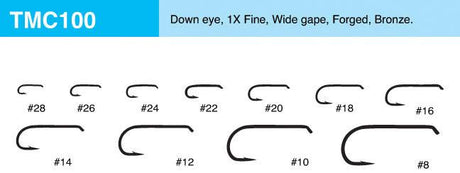
Hook sizing explained
Fly hook sizes follow a numbering system where bigger numbers are smaller hooks:
- Size 2 is larger than size 16
- Size 20 is smaller than size 14
Very large hooks are often labeled with “aught” sizing:
- 1/0, 2/0, 3/0 and larger are common for big streamers, bass, pike, and saltwater flies
Because sizing and shape can vary between manufacturers, once you find a model that matches your patterns well, it often makes sense to stick with that brand/model for consistency.
Simple hook size chart (general guide)
| Fly type | Common hook sizes |
|---|---|
| Small dry flies (midges, tiny mayflies) | 16–22 |
| Standard dry flies (mayflies, caddis, attractors) | 12–16 |
| Nymphs and emergers | 10–18 |
| Jig nymphs (Euro, Perdigons) | 12–18 |
| Small streamers | 8–12 |
| Large streamers | 2–6 |
| Bass / predator | 1–2/0 |
This chart is a general guideline; wire weight, gap, and shank length all affect the final fly size and how it fishes.
Common hook styles and popular models
Dry fly hooks
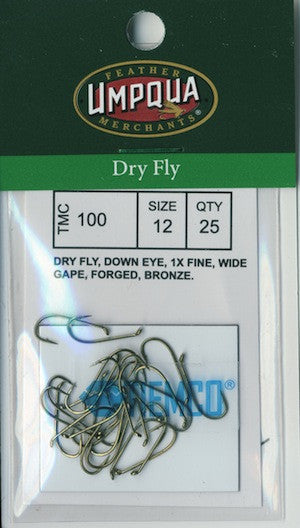
Best for: Mayflies, caddis, midges, and attractor dries where light wire and flotation matter.
Popular models:
Tiemco TMC 100
Hanak 100 BL / 130 BL (barbless)
Lightning Strike DF1
Shop: Dry Fly Hooks | Tiemco Hook Chart
Nymph and curved nymph hooks
Best for: Beadhead nymphs, emergers, and general subsurface patterns.
Popular models:
Tiemco TMC 3761 / 2457 / 2487
Hanak 230 BL / 300
Fulling Mill nymph and competition hooks
Shop: Nymph Hooks | Fulling Mill Hooks
Jig hooks
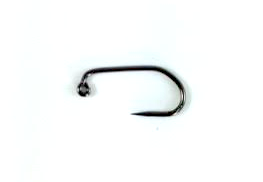
Best for: Euro nymphs, Perdigons, and point-up rigs paired with slotted beads.
Popular models:
Hanak 400 / 450 / 470
Umpqua U 555
Kumoto KJ310 Wide Gap Jig
Shop: Jig Hooks | Hanak Hooks & Beads
Streamer hooks
Best for: Woolly buggers, baitfish, articulated and predator streamers.
Popular models:
Hanak 950 Streamer XL
Tiemco TMC 5262
Ahrex streamer and predator hooks
Shop: Streamer Hooks | Ahrex Hooks
Barbless hooks
Best for: Catch-and-release fishing, competitions, and regulation-sensitive waters.
Popular models:
Firehole Sticks series
Hanak barbless competition hooks
Fulling Mill barbless hooks
Shop: Barbless Hooks | Fulling Mill Hooks
Best hook styles for beginning fly tiers
If you’re building your first hook selection, a small set of versatile styles covers the majority of classic patterns and modern techniques:
- Standard dry fly hook in sizes 12–18 (learn proportions and thread control)
- Curved nymph hook in sizes 12–16 (beadheads, emergers, general nymphs)
- Jig hook in sizes 14–18 (pairs well with slotted tungsten beads)
- Medium to heavy-wire streamer hook in sizes 6–10 (Woolly Buggers and simple streamers)
Once you’re comfortable with these core styles, it becomes easier to add specialised hooks for specific patterns or fisheries.
Common hook selection mistakes
- Using light wire hooks for heavily weighted nymphs or streamers (bend risk and poor balance)
- Choosing a gap that’s too narrow for bulky materials (reduced hooking ability)
- Ignoring wire weight when trying to control sink rate and how the fly rides
- Using barbed hooks where barbless options are preferred or required
Matching hook design to fly type and fishing conditions helps flies fish correctly and improves consistent hook-ups.